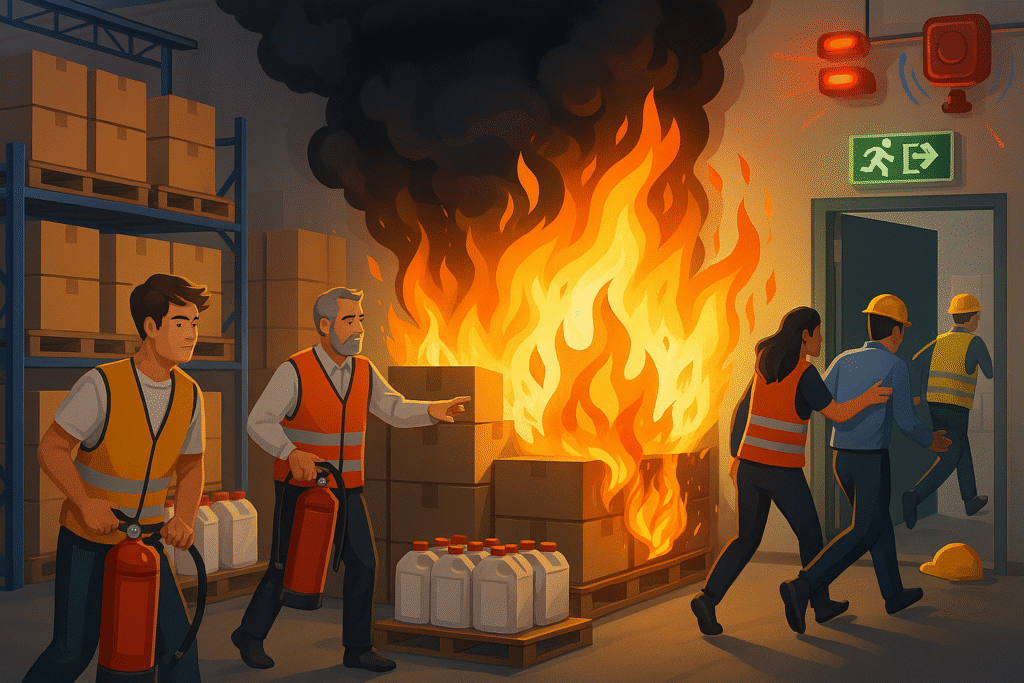
Deskripsi Pelatihan
This training is designed to equip participants with essential knowledge and practical skills in fire safety, fire prevention, and emergency response planning. Participants will learn how to identify fire hazards, develop fire prevention strategies, respond to fire incidents effectively, and comply with applicable fire safety regulations. The training emphasizes real-world applications through case studies, hands-on demonstrations, and collaborative planning workshops.
Tujuan
-
Understand the basic principles of fire science and fire classification.
-
Identify potential fire hazards in the workplace and assess fire risks.
-
Apply fire prevention and protection measures effectively.
-
Use fire extinguishers and other firefighting equipment correctly.
-
Develop and implement a fire emergency response plan.
-
Conduct fire drills and evacuation procedures.
-
Comply with local and international fire safety standards and regulations.
Target Peserta
-
Health, Safety, and Environment (HSE) Officers
-
Emergency Response Team (ERT) members
-
Supervisors and Operations Managers
-
Facility and Building Maintenance Personnel
-
Fire Safety Coordinators
-
Security Personnel
-
Employees working in high-risk environments
-
Internal trainers or K3 facilitators
Silabus
Module 1: Introduction to Fire Safety Awareness-
Importance of fire safety in the workplace
-
The impact of fire incidents: human, operational, and financial
-
Building a culture of fire prevention and preparedness
-
The fire triangle: fuel, heat, oxygen
-
Fire development and spread
-
Fire classifications (Class A, B, C, D, K)
-
Common causes of workplace fires
-
Identifying potential fire hazards (electrical, chemical, mechanical)
-
Fire risk assessment techniques
-
Inspection tools and fire hazard checklists
-
Mapping fire-prone areas in the workplace
-
Active protection: fire alarms, detectors, extinguishers (APAR), hydrants, sprinklers
-
Passive protection: fire-resistant walls, doors, and escape routes
-
Fire extinguisher types and applications
-
Fire extinguisher use (PASS method): Practical hands-on session
-
Principles of emergency response planning
-
Roles and responsibilities of Emergency Response Teams (ERT)
-
Creating an effective evacuation plan
-
Assembly points and headcount procedures
-
Addressing people with disabilities during evacuation
-
Planning and organizing a fire drill
-
Simulating realistic fire emergencies
-
Team coordination and communication during emergencies
-
Post-drill evaluation and continuous improvement
-
Overview of local fire safety regulations (e.g., Ministry of Manpower, Fire Department codes)
-
Introduction to international standards: NFPA, OSHA, ISO 45001
-
Internal fire safety audits and documentation practices
-
Key components of a comprehensive Fire Safety Plan
-
SOPs for fire prevention, response, and equipment maintenance
-
Fire safety training schedules and inspection checklists
-
Group workshop: Designing a site-specific fire safety plan
-
Post-test: Assessing knowledge gained
-
Practical evaluation: Use of fire extinguishers and evacuation simulation
-
Group presentations of Fire Safety Plans
-
Participant feedback and reflection
-
Awarding of training certificates
Fasilitas
- Modul pelatihan dan seminar KIT
- Makan siang dan rehat kopi.