Tujuan
-
Identify common fire and explosion hazards in hazardous areas on ships.
-
Distinguish between intrinsically safe and non-intrinsically safe equipment, and their appropriate use.
-
Understand how static electricity can trigger explosions, and how to control or prevent it.
-
Apply correct procedures for earthing and bonding to minimize ignition risks.
-
Use gas analyzers and measuring instruments safely and effectively.
-
Understand the function and critical role of Emergency Shutdown Systems (ESD).
-
Conduct or support routine inspection and maintenance of explosion-protected (Ex) equipment.
-
Interpret and implement guidelines related to dust hazards and their mitigation.
-
Improve hazard awareness and enhance personal safety accountability in hazardous zones.
Target Peserta
-
Deck and engine officers on oil, gas, and chemical tankers
-
Electricians and ETOs (Electrical Technical Officers)
-
Safety Officers and Environmental Officers
-
Marine engineers and technical superintendents
-
Onshore personnel involved in HSE or maintenance planning
-
New joiners assigned to hazardous zones or with limited Ex exposure
Silabus
1. Common Hazards, Hazardous Areas and Guidelines-
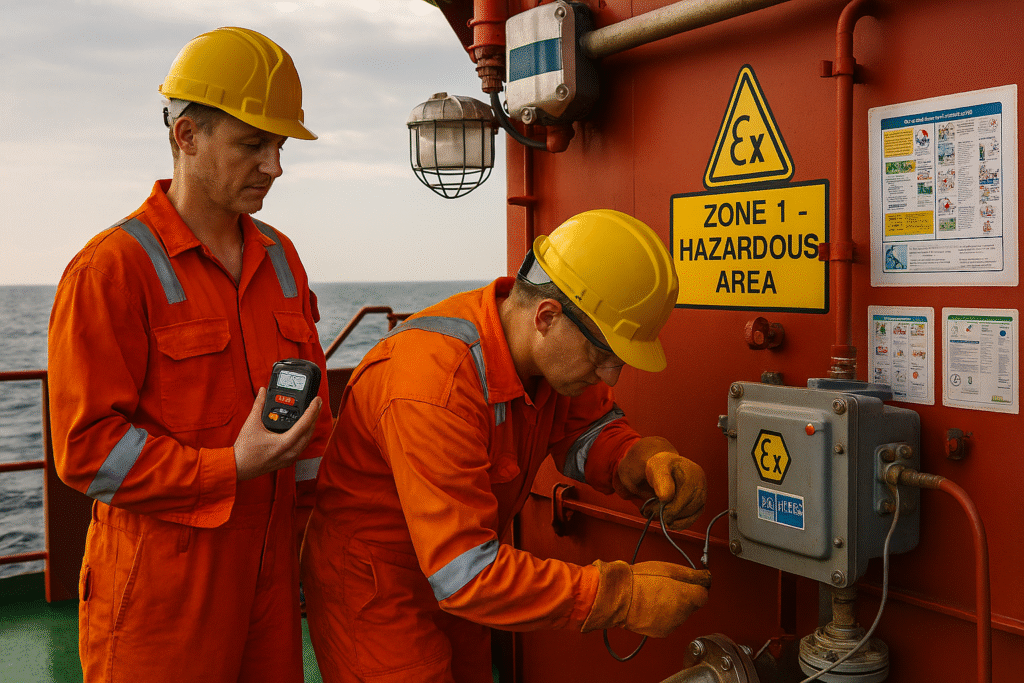
Introduction to hazardous zones on ships (Zone 0, 1, 2)
-
Sources of fire/explosion in shipboard operations
-
Regulatory guidelines (SOLAS, ISGOTT, IECEx)
-
Hazardous area classification and marking systems
-
Basic behavior and awareness in Ex environments
-
How dust can lead to fires or explosions (combustible dust risk)
-
Examples in maritime and offshore environments
-
Dust cloud formation and ignition risk
-
Ventilation and housekeeping standards
-
Relevant IMO/industry safety practices
-
Understanding the dangers of using standard (non-Ex) equipment
-
Types of equipment not permitted in hazardous areas
-
Risks: heat generation, spark potential, open circuit faults
-
Case studies of past incidents caused by inappropriate equipment use
-
What makes equipment “intrinsically safe”
-
Standards and certifications (IECEx, ATEX Zone classification)
-
Examples: radios, sensors, handheld tools
-
Maintenance and use in explosive environments
-
Limitations and user responsibilities
-
How static electricity is generated onboard
-
Conditions for static discharge and ignition
-
Examples: tank cleaning, cargo transfer, fuel loading
-
Control measures: inerting, humidity control, proper materials
-
Purpose of earthing and bonding in hazardous areas
-
Principles of safe electrical connection to prevent discharge
-
Differences between earthing vs. bonding
-
Inspection and continuity testing procedures
-
Typical bonding practices during cargo operations
-
Types of gas detection equipment (fixed and portable)
-
Operation and calibration of gas analyzers
-
Oxygen, hydrocarbon, H₂S detection
-
Correct usage in pre-entry, hot work, enclosed space entry
-
Limitations and sensor maintenance
-
Role of ESD in preventing escalation during an emergency
-
Components and activation logic
-
Integration with cargo and machinery systems
-
Manual and automatic triggers
-
Crew response and drills involving ESD
-
Importance of regular inspections and preventive maintenance
-
Visual and close inspection techniques
-
Common failure points (seals, enclosures, corrosion)
-
Documentation and maintenance records
-
Working with certified personnel and verifying compliance
Fasilitas
- Modul pelatihan dan seminar KIT
- Makan siang dan rehat kopi.